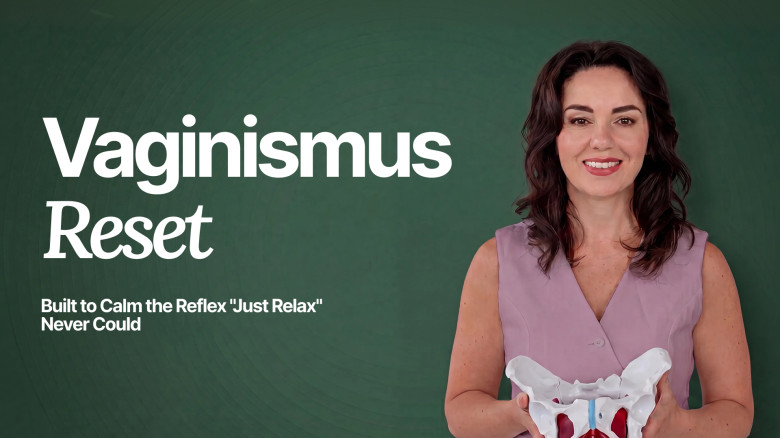
Vaginismus Reset: Calm the Pelvic Floor Reflex Behind Painful Intimacy — at Home, with a Women's Pelvic Health Specialist
You've been told to relax. To have a glass of wine. That it's all in your head. That maybe you're "just too small." None of it worked — because none of it was true. Painful intimacy, the "brick wall" feeling, a body that closes before you choose: that's not weakness and it's not in your head. It's a pelvic floor that has learned to guard — to clench on its own, like a fist that won't unclench. In just 10 minutes a day, Vaginismus Reset gently retrains that reflex, so your body stops bracing and starts feeling safe again. Built by Lilia Mainskaya, a women's pelvic health specialist who treats exactly this, every day.
We guarantee to refund the course purchase price, if the course did not meet your expectations. To request a refund, please email our Support Service at [email protected] within 14 calendar days from the purchase date.
Comments about the course
-

I couldn't use a tampon at 16 and just assumed I was built wrong 😞 By my late twenties intimacy was off the table completely. Two doctors told me to 'relax and have a glass of wine.' This course was the first time anyone explained it was a reflex — not me being broken. Six weeks in and I used a tampon for the first time in my life. I sat on the bathroom floor and cried 😭
-

My husband was endlessly patient but I felt like I was failing him every single month 💔 The fear got so big I'd tense up just from him hugging me. The breathing and release work undid something I didn't think could be undone. We're not 'fixed' overnight — but for the first time there's no panic. There's hope 🙏
-

I dreaded my smear test for a literal YEAR. Cancelled it twice (( The bonus exam lesson alone was worth it — I went in, did the breathing, and it didn't hurt. The nurse asked what I'd changed. I nearly burst into tears in the chair 😭
-

3 years of avoiding intimacy and pretending I was 'just tired' !! I'd convinced myself this was my life now. Lesson 1 explained the fear-tension-pain loop and it was like someone finally turned the lights on. It's the first thing that ever made sense 💛
-

I'd tried Kegels for months because that's what I was told to do — and everything only got tighter 😤 Turns out I was doing the EXACT wrong thing. Learning to release instead of squeeze changed everything in weeks. Nobody had ever told me there was a difference 🔥
-

After years of being told it was anxiety, in my head, all psychological — having a specialist calmly say 'this is a physical reflex and it's reversible' broke me open in the best way!! I stopped hating my body. That alone was worth every penny 🙏
Course includes
It's Not In Your Head. It's Not That You're Broken. It's a Reflex.
Does any of this sound like you?
- Intimacy hurts — or feels impossible, like hitting a wall
- Your body tenses on its own, even when you want closeness
- You can't insert a tampon, or it's painful every time
- You dread smear tests and pelvic exams for weeks beforehand
- Burning or stinging at the first sign of pressure
- You've started avoiding intimacy — and the guilt that comes with it
- A doctor told you to "just relax" or that you're "too small"
- Someone made you feel it was your fault, or in your imagination
- You feel broken, or like you're failing your partner
- The fear of the pain has grown bigger than the pain itself
It's not that your body is broken. After actual or anticipated pain, your pelvic floor learned to protect you — it clenches involuntarily, the way a jaw clenches before a hit. Fear leads to tension. Tension leads to pain. Pain leads to more fear. Relaxing "harder" was never going to break that loop, because the reflex isn't a choice. But it can be retrained — gently, at your own pace, in private.
Finally Be In Your Body Without Bracing
In just 10 minutes a day with Vaginismus Reset:
- Calm the guarding reflex at the root — not just the symptom
- Teach your pelvic floor to release on command (the opposite of Kegels)
- Break the fear-tension-pain loop your nervous system is stuck in
- Use a tampon and sit through a pelvic exam without the dread
- Reconnect with your body through gentle, pressure-free steps
- Approach intimacy on your terms, without bracing for pain
- Replace shame with a clear understanding of what's happening
- Move from "I'll never be normal" to steady, real progress
- Feel touch and closeness become safe again — not something to brace against
- Reclaim closeness at your own pace, in your own time
Your body was never the enemy. A guarding reflex is. And now you have a method that retrains it. Start your reset today.
How Will Vaginismus Reset Work For You?
1. Map the guard first. Start with simple self-checks to understand exactly where and when your pelvic floor clenches, and how the fear-tension-pain loop is running. No guesswork — just clarity, and the shame starts lifting here.
2. Calm & release. Learn diaphragmatic breathing and conscious release to down-regulate the nervous system and teach the pelvic floor to let go — the opposite of Kegels.
3. Soften the tissue. Restore ease to muscles that have been bracing for months or years. Progressive relaxation and gentle self-approach bring softness back — without pain, without force.
4. Reconnect with your body. Rebuild safety and ownership through body and mirror work. Stop bracing, release the shame layer, and feel your body as yours again.
5. Interrupt the fear-tension-pain loop. Somatic awareness techniques so anticipation stops triggering the clench — the complete cycle nobody ever helped you break at once.
6. Integrate into your life. Carry the calm into daily life and toward intimacy. Make it yours, and keep it for good.
Why choose this course?
Other advice tells you to relax or push through. This retrains the reflex itself.
- Built by a specialist who treats vaginismus in clinic every day — not theory.
- Teaches downtraining (release) — the opposite of the Kegels so many women are wrongly given.
- Works on body and mind — the fear loop, not just the muscle.
- No dilators forced on day one. You start exactly where your body actually is.
- Fully private, at home, at your pace — no stirrups, no waiting list, no exam table.
- You're not broken. This doesn't "manage" your pain. It retrains the reflex causing it.
Academic plan
23 video lessons
- Intro
- Understanding the Guarding Reflex — Where the Pain Is Really Coming From
- Releasing Tension in the Pelvic Floor and Surrounding Muscles
- Improving Awareness and Mobility of the Pelvis
- Pelvic Floor Release and Body Alignment
- Gentle Release Practice Adapted for Sensitive Bodies
- Releasing Deep Pelvic Floor Tension
- Diaphragmatic Breathing and Pelvic Floor Coordination
- Connecting Breath, Body and the Pelvic Floor in Movement
- Gentle Body Activation Without Triggering the Guard
- Gentle Release Practice Adapted for Sensitive Bodies
- Self-Release for the Inner Thigh and Pelvic Floor Approach
- Progressive Relaxation for the Pelvic Floor and Surrounding Muscles
- Self-Release for Tissue Softening and Deep Relaxation
- Nervous System Techniques for Pelvic Floor Reset
- Gentle Release Practice Adapted for Sensitive Bodies
- Using Breathwork to Interrupt the Fear-Tension-Pain Loop
- Connecting Breath, Mind and Body in Full Relaxation
- Mirror and Body-Connection Work for Shame Release
- Full Pelvic Floor and Whole-Body Relaxation Practice
- Gentle Release Practice Adapted for Sensitive Bodies
- Final Lesson
- Bonus Lesson — Calming the Guard Before a Pelvic Exam

After payment, you can immediately start practicing
- Click the "Get Access" button, enter your email in the field and you will be taken to a secure payment page.
- Complete the order process and you will instantly receive a password to access your personal NEWMINDSTART account.
- Take lessons, perform practical tasks, ask the author questions and discover new courses.
FAQ