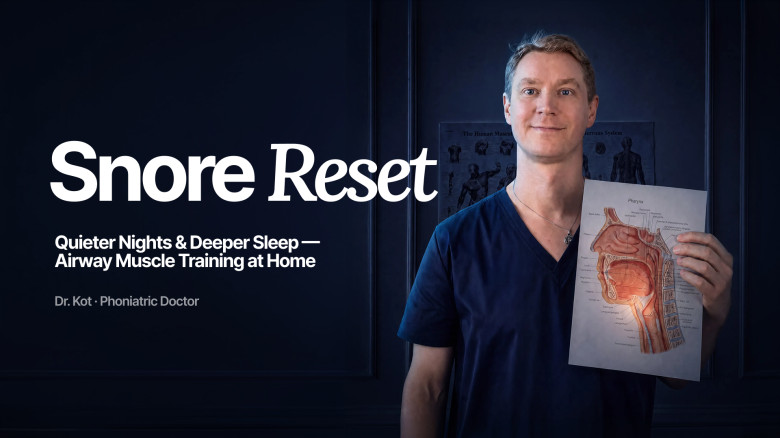
Snore Reset: Quieter Nights & Deeper Sleep — Airway Muscle Training at Home
You've been told it's just your age. That women your age snore, that it comes with the territory, that you should lose a little weight and wait it out. So you stopped mentioning it. You sleep facing away. Maybe he moved to the spare room. None of the strips, tapes, or pillows worked — because none of them train the muscles that actually collapse at night. Snore Reset works on the cause: the airway muscles that went slack. Built by a phoniatric doctor with 15+ years treating exactly this. Just 5 minutes a day. No devices, no CPAP, no surgery.
We guarantee to refund the course purchase price, if the course did not meet your expectations. To request a refund, please email our Support Service at [email protected] within 14 calendar days from the purchase date.
Comments about the course
-

I'd stopped sleeping over at my boyfriend's, I was that embarrassed 😞 Two weeks of these exercises and he told me — unprompted — that I'd gone quiet in the night. I actually teared up. Nobody ever told me it was a muscle thing.
-

My husband moved to the spare room TWO YEARS ago. I'd accepted it. Week 3, he came back to bed 😭 I'm not exaggerating. Five minutes a day on the sofa while the kettle boils.
-

What got me was the 'it's not your age' line on this page. That's word for word what three doctors told me 🚩 Turns out it was never my age — it was muscles nobody bothered to check.
-

I tried the CPAP. Hated it — the mask, the noise, the hose, I gave up in a week 😩 This is just… exercises. No machine. I wake up without the dry mouth and the headache for the first time in years.
-

Week 1 → still skeptical. Week 2 → quieter, apparently. Week 3 → slept through without waking myself up. Week 4 → my daughter said I look 'less wrecked' 😂 Rude, but true.
-
I used to wake up more tired than when I went to bed. I thought that was just life past 50 😮💨 It isn't. I get up now and I'm actually there. Wish I'd found this years ago.
Course includes
It's Not Your Age. It's the Airway Muscles No One Ever Trained.
Are these familiar?
- You wake up after a full night and still feel exhausted
- You've been told — or quietly decided — it's "just your age"
- Your partner has moved to the spare room, or sleeps facing away
- You're embarrassed by it, like it's a secret you have to hide
- You're afraid to fall asleep first, or to sleep anywhere but home
- Dry mouth and a sore throat greet you most mornings
- You snore louder, and more nights, than you used to
- You've tried strips, tape, special pillows, side-sleeping — nothing held
- You tried a CPAP or a mouthguard and couldn't stand it
- Deep down, you worry it's doing something to your health
Here's what nobody tells you
Snoring isn't a habit, and it isn't your age. It's weak muscles. While you sleep, the muscles that hold your airway open — your tongue, soft palate, and throat — relax too far. Your tongue slides back. The soft palate starts to vibrate. The airway narrows. That vibration is the snoring. That narrowing is why you wake up tired even after eight hours.
That's the loop: weak muscles → the airway collapses → you snore → your sleep never goes deep → you wake unrefreshed → and with every year, the muscles get a little weaker. It isn't in your head that it got worse with age. After 40, the muscle tone that kept your airway firm starts to drop — which is exactly why this is muscle work, not a gadget.
And snoring isn't always just noise. For a lot of people, that same airway narrowing is the early edge of sleep apnea — which is exactly why it's worth training these muscles now, while it's simple.
Tape holds your mouth shut. Strips prop your nose open. Pillows tilt your head. A CPAP forces air past the problem. None of them rebuild the muscle that's collapsing — so the moment you stop, the snoring comes back. Strengthen those muscles, and the airway holds itself open. That's what Snore Reset does.
Finally Sleep Quietly — And Wake Up Rested
In just 5 minutes a day with Snore Reset:
- Quieter nights — for you, and whoever sleeps near you
- Wake up actually rested, not foggy and drained
- Retrain the tongue so it stops falling back at night
- Tone the soft palate and throat so they stop vibrating
- Stop bracing for the bedroom — no more sleeping apart
- Lose the dry mouth and the morning sore throat
- More energy and a clearer head through your day
- A natural fix you keep — no device to wear forever
Your sleep isn't broken, and you're not too old. The right muscles were simply never trained. Now they will be.
How Snore Reset Works
1. See where it's collapsing. Simple checks show you what's happening in your own airway at night — tongue, palate, throat — so you know exactly what you're training. No guessing.
2. Wake up the tongue. The tongue is the muscle that falls back and blocks the airway. Targeted myofunctional exercises rebuild its tone so it stays forward while you sleep.
3. Open the throat. Gentle work on the larynx and soft palate — the tissues that actually vibrate — so there's less there to make the noise. This is the snoring, at its source.
4. Release what tightens the airway. Neck, jaw, and shoulder tension quietly narrows the airway. We let it go so everything above can do its job.
5. Anchor it with posture. How you hold your head and neck decides how open your airway sits. One posture reset keeps the gains in place.
6. Lock it in nightly. A short, complete routine before bed — five minutes — that keeps your airway trained and your nights quiet. No equipment, no clinic.
Why choose this course?
Everyone muffles the sound. This trains the muscle making it.
- Built around one mechanism — the airway muscles — not generic sleep tips
- Created by a phoniatric doctor, from the method he's used for 15+ years — clinical work, home format
- Targets the real cause, not a device that covers it up
- 5-minute daily format — no gym, no machine, no mask
- Natural, and yours to keep — the muscle tone stays after you'd have to keep buying the gadgets
- For the woman who was told it's "just her age" — and never given the real reason, or the fix
Academic plan
13 video lessons
Before we dive in, I want to introduce myself and walk you through how I've structured this course, so you know exactly what to expect and how to get the most out of every lesson.
In this lesson I'll show you the three muscles behind your snoring — your tongue, soft palate, and larynx — and how your grimace muscles quietly activate them, then guide you through a simple self-test so you can pinpoint exactly where your own snoring starts.
Your tongue is the muscle that falls back and blocks the airway while you sleep. Learn the resting position that keeps it forward — the foundation everything else builds on.
A weak tongue slides back the moment you relax into sleep. These targeted exercises rebuild its tone so it stays in place through the night.
A tight, restricted throat narrows the very space your air has to move through. Gentle work on the larynx opens it up and takes pressure off the airway.
The soft palate is the tissue that vibrates and makes the snoring sound. Here you train it to lift and firm up — so there's less there to rattle at night.
Deep neck tension quietly compresses the airway without you noticing. Releasing it gives the muscles above the room they need to do their job.
The jaw, shoulders, and throat are connected — tightness in one pulls on the rest. This lesson lets that tension go so your airway sits open and unstrained.
How you hold your head and neck decides how open your airway stays at night. One simple posture reset keeps everything you've trained in the right place.
Everything comes together in one short routine you do before bed. Five minutes a night to keep your airway trained and your sleep quiet — for good.
I'll walk you through my go-to set of soft palate exercises — from nose taps to holding your palate up with a spoon — that target the exact muscles responsible for that fluttering, vibrating sound.
Here I'll teach you the tongue exercises I rely on to build real strength and control, so your tongue stops collapsing backward and blocking your airway at night.
In this lesson I'll share my favorite larynx and facial articulation exercises — including the yawn stretch, neck stretches, and my "lion's roar" — to open up and strengthen your upper airway from every angle
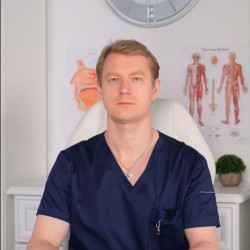
After payment, you can immediately start practicing
- Click the "Get Access" button, enter your email in the field and you will be taken to a secure payment page.
- Complete the order process and you will instantly receive a password to access your personal NEWMINDSTART account.
- Take lessons, perform practical tasks, ask the author questions and discover new courses.
FAQ