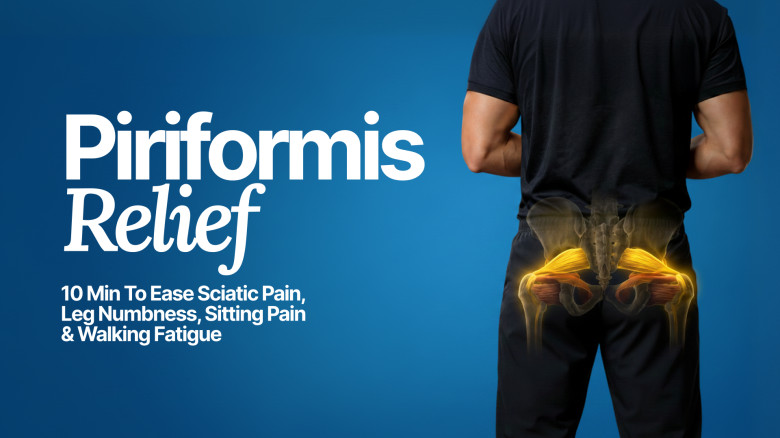
Piriformis Relief: Simple Exercises for Piriformis Syndrome, Sitting Pain & Walking Discomfort
The Piriformis Is Working Overtime — And You Don't Even Know It. You get in the car — and immediately feel one side of your buttock “burning.” You stand up after a long day — and the first few steps are the hardest. Your leg goes numb if you sit even a little longer than usual. This course is built around one small muscle almost nobody checks — the piriformis. Just 10 minutes a day: diagnostics, tension-release techniques, gentle rocking movements, and ball-massage work — to take pressure off the sciatic nerve and give your body its freedom of movement back.
We guarantee to refund the course purchase price, if the course did not meet your expectations. To request a refund, please email our Support Service at [email protected] within 14 calendar days from the purchase date.
Comments about the course
-

For three months I couldn't sit through a normal day — the sciatic pain would shoot down so badly I'd have to get up in the middle of work calls. Saw a neurologist, took nerve medication — zero effect. Turned out it was my piriformis pressing on the nerve, and nobody had ever checked it. Three days into the release exercises and it was already noticeably better.
-

My leg would go numb just from sitting — after 15-20 minutes my foot would start 'buzzing,' like an electric current. I thought it was diabetes or a pinched nerve in my back, got bloodwork done, an ultrasound on my legs. Everything came back clean. Turned out it was the piriformis, and once I addressed it I could finally sit through a full workday without shifting seats for the first time in a year.
-

Climbing stairs was a real ordeal — by the 3rd or 4th step the pain would shoot down my leg and I'd have to freeze mid-step. My wife thought it was just age catching up, I was preparing myself for spine surgery. Turned out it was just piriformis spasm. Now I climb five flights without a single shooting pain.
-

The pain in my buttock was so bad I was getting massages twice a week for a month — it would loosen up temporarily, then come right back the next day. My massage therapist never even mentioned the piriformis, just worked on the surface muscles. The moment I started targeting that specific muscle, I finally felt pain that didn't come back the next day.
-

Lower back pain while walking had been bothering me for almost a year. My doctor sent me straight for a lower-back MRI 'just to check the discs.' The MRI came back clean, but the pain stayed. It was only when I started digging on my own that I found the piriformis — and realized it was the one referring pain into my lower back while walking. Two weeks of exercises in and I'm walking without that dragging pain that used to hit after just one block.
-

It started with not being able to sit at my desk for more than half an hour — my buttock and leg would just feel heavier and heavier. Saw an orthopedist, got a hip X-ray — was told it was 'just age-related changes, nothing serious.' Turns out 'nothing serious' was a locked-up piriformis that nobody had ever tested on its own. Now I sit through hour-long meetings and forget that used to be a problem at all.
Course includes
This Is What Life Looks Like When Your Piriformis Is In Spasm
- A nagging ache in one buttock that never quite goes away
- Pain that runs down the back of your thigh — sometimes past the knee
- Your leg goes numb or “falls asleep” after just 15–20 minutes of sitting
- Asymmetry — one side of your pelvis hurts more than the other
- It's hard to get up from a chair or climb the stairs
- Pain flares after running, squats, or a long drive
- Doctors say “sciatica” or “herniated disc” — but your spine MRI is clean
- Stretching helps for an hour — then it's right back
- You've been training your glutes for months — but they still won't grow
Here's What Usually Gets Missed
The piriformis is small, deep, and tucked underneath your glutes. But the sciatic nerve runs right next to it — and in many people, straight through it. The moment this muscle tightens or spasms, it starts pressing on the nerve, sending pain down the leg that feels exactly like a spinal problem. A tight, overworked piriformis also blocks your glutes from firing properly — which is why no amount of squats or lunges seems to build them. That's where the confusion with other diagnoses comes from. The muscle itself is rarely checked on its own — and it should be.
Piriformis Relief Gives Your Body The Signal It's Been Missing.
Finally Know What's Causing It — And Have A Protocol To Fix It
- Releases piriformis spasm with targeted techniques
- Takes the pressure off the sciatic nerve
- Restores mobility in the hip joint
- Lets your glutes fire and engage properly again
- Lets you sit through a flight, a meeting, or dinner without shifting
- Clears that numbness and tingling in your leg
- Teaches your body to release tension on its own — no clinic, no equipment
How Piriformis Relief Works
1. Find what's actually hurting. Simple self-tests pinpoint exactly where your piriformis is tight and confirm whether it's the one pressing on your sciatic nerve. No guessing — a clear map of what needs attention before you touch a single exercise.
2. Release the primary problem. Targeted tension-release and ball-massage work directly on the piriformis itself — taking the pressure off the nerve at the source, not just easing the symptom.
3. Clear everything else that's feeding it. Pelvic position, hip rotation, and the other tight spots around it that keep pulling the piriformis back into spasm — so the release doesn't get undone the next time you sit down.
4. Lock in the result. Stabilisation work that teaches your hip and glutes to hold the correction — through sitting, walking, and daily life — instead of slipping back into the old pattern.
5. Remember the 10-minute morning reset. A short daily routine that keeps this whole area calm going forward — simple prevention, not another thing to fix later.
Why choose this course?
- Targets the actual cause — the piriformis and the sciatic nerve — not pain in general
- Combines diagnostics, tension work, movement, and self-massage — not stretching alone
- 10 minutes a day, at home, no equipment except a ball
- Works both during a flare-up and as ongoing prevention
- Built on a clinical protocol — not generic advice from the internet
Academic plan
9 video lessons
- Neck, Thoracic and Lumbar Posture Assessment
- Movement Pattern Assessment — Sitting Posture, Hip Rotation, Gait
- Breathing and Energy Locks Practice
- Foam Roller Release for Hips & Piriformis
- Rocking Mobilisation for Deep Support
- Hip Rotator & Glute Stabilisation Training
- Full-Body Flow for Hip Stability
- Daily Maintenance Protocol Diaphragm
- Daily Maintenance Protocol Posture

After payment, you can immediately start practicing
- Click the "Get Access" button, enter your email in the field and you will be taken to a secure payment page.
- Complete the order process and you will instantly receive a password to access your personal NEWMINDSTART account.
- Take lessons, perform practical tasks, ask the author questions and discover new courses.
FAQ