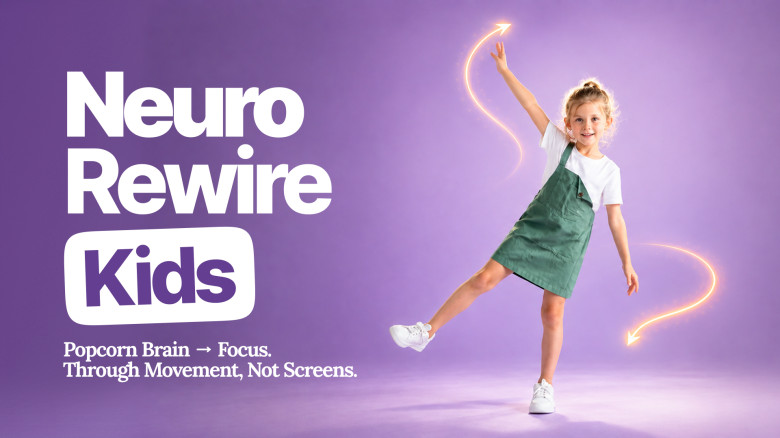
Neuro Rewire Kids: Rebuild Your Child's Attention Span Through Movement — Screen-Free, in Just 10 Minutes a Day. Ages 3–10.
Homework takes an hour for ten minutes of work? Bored two minutes into any real game? Asks "what's next?" before the first thing is even finished — and only ever settles when something is playing on a screen? You're not alone, and it's not laziness. It's a brain that got trained to expect a new hit every few seconds. Neuro Rewire Kids rebuilds attention the way the brain actually builds it — through movement. Simple cross-body dance routines that ask your child's brain to do the one thing screens stopped asking of it: stay with something, and finish it. Just 10 minutes a day. Lifetime access. Don't take the screen away — retrain what it trained.
We guarantee to refund the course purchase price, if the course did not meet your expectations. To request a refund, please email our Support Service at [email protected] within 14 calendar days from the purchase date.
Comments about the course
-

He finished a whole page of a book. Sounds like nothing — it was the first time in about a year 😭 Three weeks in and I'm not sitting next to him at the table every night anymore. He was never lazy. His brain just needed different practice.
-

I stopped taking the iPad away and that alone changed our house 🙏 We do the ten minutes before dinner instead. He asks for it now. And the constant begging for the tablet just… dropped off on its own.
-

My 5 y.o said 'I'm bored' about four seconds after I said no screens, every single day. Now she gets her own stuff out and plays. Alone. For ages 🥹 I genuinely didn't think that was coming back.
-

My son is 6 and could not follow two instructions in a row. The routines are the same thing really — do this, then this, then this. Something clicked around week two and his teacher noticed before I said anything 💚
-

I was so skeptical that dancing does anything for focus 😅 It's the mismatched moves that do it — you can actually watch him concentrating, because doing two different things at once is genuinely hard. Best $1 I've spent on him.
-

Homework used to take an hour and half of it was me nagging. Four weeks in he sits down and does it 🔥 Ten minutes a day and he thinks it's a game. Every other thing I bought lasted four days.
Course includes
When Nothing Holds Their Attention Anymore — It's Not Laziness
Sound familiar?
- Homework takes an hour for ten minutes of work
- Bored two minutes into any real game or toy
- Asks "what's next?" before the first thing is finished
- You say something three times and it still doesn't land
Here's what almost no one tells parents: that's not laziness, and it's not their personality. Experts call it popcorn brain — attention that pops from one thing to the next and can't settle. It isn't a diagnosis. It's a description of what fast content does to a growing brain. In 2004, the average person stayed on one screen for about two and a half minutes before switching. Today it's under fifty seconds. Your child is growing up inside that speed, and everything slower — reading, playing, waiting, listening to you — starts to feel unbearable by comparison.
That's why the usual fixes backfire. Every piece of advice you get is subtraction — cut the screens, set a timer, take the tablet. So you fight about it every evening, you feel like the villain, and the moment screens come back so does everything else. Taking something away doesn't rebuild attention. Nothing was ever put in its place.
And the second thing parents are told is worse: make them sit still and focus. Researchers now say that's backwards. A child sitting perfectly still can be completely checked out, while a moving child is often the one actively working to stay with the task. Stillness was never the same thing as attention.
And here's the part worth knowing now: attention is most trainable in early childhood, while the brain is still most adaptable. The years before about 10 are the best window to build it — before the pattern sets harder.
The problem was never your child. Nobody gave their brain the reps that attention is actually made of.
The Screen-Free Way to Rebuild Attention — Through Movement, Not Willpower
That is exactly what Neuro Rewire Kids is.
Created by a neuropsychologist, it's a library of short, screen-free dance routines built to do one job: take a brain trained on speed and teach it to hold still again. The routines get deliberately harder to autopilot — one side doing something different from the other, sequences that get longer week by week — so your child's brain has to stay present to keep up. No apps. No worksheets. No nagging. And because it's music and movement, they don't experience it as training.
- Rebuild attention span through daily movement
- Stretch how long your child can stay with one thing
- Build the focus that homework and school actually run on
- Bring back the ability to play without a screen
- Improve coordination, sequencing and self-control along the way
- Add something they enjoy instead of taking something away
No more standing over them at the kitchen table. Just a child who can start something and finish it.
What Changes, Week by Week
Week 1 — finishes one task without being reminded; asks for the routine
Week 2 — homework stops being a battle; sits with a book or a toy for longer
Week 4 — focused, self-directed, present — like a different kid
How It Works
This isn't an app or an activity book. It's a simple daily routine built on how a child's brain actually builds attention.
Step 1 — Wake both sides. Simple cross-body moves get the two halves of the brain working together again — the foundation everything else sits on.
Step 2 — Cross the middle. Reaching across the body is the core rep. It's the movement that builds the bridge between the two sides of the brain.
Step 3 — Break the autopilot. Each side does something different at the same time. Now the brain can't coast — it has to stay awake and keep up.
Step 4 — Steady the body. Balance work builds the physical control that sitting still and staying with a task depend on.
Step 5 — Hold the sequence. Routines get longer week by week, so attention has to stay with one thing a little longer each time — and ends with slow, quiet moves that build the pause screens never ask for.
You'll see the change in days: fewer reminders, faster homework, a child who finishes things.
Why choose this course?
- You add something instead of taking something away. No timer wars, no confiscation, no being the bad guy.
- Built by a neuropsychologist. Rhythm and cross-body movement are established tools in child development — not a parenting hack.
- They ask to do it. It's dance and music, ten minutes. Kids don't experience it as work, which is the only reason it survives past day four.
- Nothing to buy, nowhere to go. Living room floor, no equipment, no app for your child to get hooked on.
- More than focus. The same wiring behind attention also builds coordination, sequencing, balance and self-control.
- Ages 3 to 10, one program. Every child follows the same routines at their own level.
Academic plan
27 video lessons
- 1. Welcome to Neuro Rewire Kids
- 2. How Beats Turn On the Brain
- 3. Jumpstart Joy: Brain-Body Warm-Up
- 4. Activate Both Sides of the Brain with Fun Beats
- 5. Simple Clapping Warm-Up
- 6. Super Easy Dance Combo
- 1. About Smarty Dance Steps — Theory
- 2. Funny Cross Crawls
- 3. Beat Catchers: Coordinating Moves with Music & Balls
- 4. Line & Triangle
- 5. The Box and the Ribbons
- 6. Jump, Clap, Family Snap!
- 1. Mismatch Move
- 2. Clocks
- 3. Marching Soldiers
- 4. String Puppets
- 5. The Elevator Game
- 6. Stand Tall, Clap Loud!
- 2. Stand Like a Superhero
- 3. The Shaky Planet Mission
- 4. Play and Balance
- 2. Square Hop Challenge
- 3. Sync & Clap: Advanced Beats
- 4. Sit, Clap, Smile!
- 5. Use the Rhythm to Calm the Brain
- 6. Reach & Relax: Happy Stretch Time
- 7. My Quiet Superpower





After payment, you can immediately start practicing
- Click the "Get Access" button, enter your email in the field and you will be taken to a secure payment page.
- Complete the order process and you will instantly receive a password to access your personal NEWMINDSTART account.
- Take lessons, perform practical tasks, ask the author questions and discover new courses.
FAQ