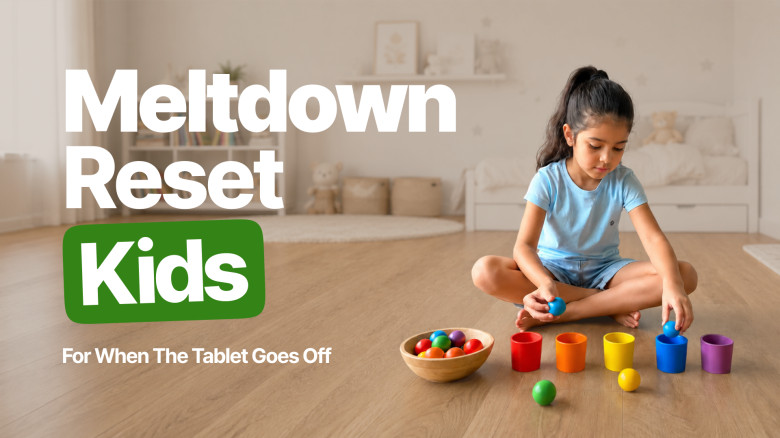
Meltdown Reset Kids: Turn the After-Tablet Meltdown into Calm — Screen-Free, in Just 10 Minutes a Day. Ages 3–10.
Beg for screens the second they're bored? Can't play alone for five minutes? Only calm when something's playing — and one "screen off" turns into a full meltdown? You're not alone, and it's not bad behavior. It's a brain that was never taught to settle itself. Meltdown Reset Kids gives your child the screen-free games experts actually recommend for that exact moment — simple matching, drawing, and movement games that calm the storm and train the brain to switch gears on its own. Just 10 minutes a day. New games every week, lifetime access. Don't fight the screen — train the brain.
We guarantee to refund the course purchase price, if the course did not meet your expectations. To request a refund, please email our Support Service at [email protected] within 14 calendar days from the purchase date.
Comments about the course
-
-avatar.jpg)
My 9 y.o was glued to YouTube and impossible at bedtime. Two weeks of these screen-free games and our evenings are calm for the first time in a year 🙏 She asks for it now. I didn't believe the other reviews — now here I am writing one.
-

Best thing my 6 y.o said after a game: 'Mama, I turned my mad off' 😭 He NAMES the feeling now instead of exploding. Week 1 to Week 4 — genuinely like a calmer kid.
-

Best $1 I've ever spent, no exaggeration 🔥 Other parents are on therapy waitlists for this — we did 10 mins a day at home and the after-school screaming basically stopped by Week 3.
-

He begged for the iPad the second he got bored, then lost it when I said no. I was sure it was an addiction. Turns out he was just never taught to entertain himself 💚 Don't fight the screen — train the brain. Wish I'd started sooner.
-

My 5 y.o literally could not play alone for five minutes — always needed something on. Four weeks in she played by herself for half an hour and didn't even ask for the iPad 🥹 I forgot what a quiet afternoon felt like.
-

Every time the tablet went off = full meltdown on the floor. I genuinely thought he was just being defiant 😩 Week 2 he handed ME the tablet and went to his matching cards. I actually cried. It was never defiance — his brain just couldn't switch gears.
Course includes
When You Take the Tablet Away and the Storm Begins — It's Not Bad Behavior
Sound familiar?
- Begs for a screen the second they're bored
- Can't play alone for five minutes
- Only calm when something is playing
- One small "screen off" → full meltdown
Here's what almost no one tells parents: that's not defiance, and it's not addiction. It's a brain that was never trained to self-entertain. For kids 3–10, switching off the screen is the hardest transition of the day — after fast, stimulating input, the reasoning part of the brain can't downshift on command, so the feelings come out sideways the moment the screen goes dark.
That's why the usual fixes backfire. The "two-minute warning" most parents lean on has been shown to do the opposite of what we hope — it primes a child to brace for the fight instead of easing them out of it.
And here's the part worth knowing now: the skill of self-settling is easiest to build in early childhood, while the brain is most adaptable. The years before about 10 are the best window to teach it — before the habit sets harder.
The problem was never your child. Nobody gave the brain something to land on the moment the screen goes off.
The Screen-Free Reset for the Moment the Screen Goes Dark
Child-development experts agree on one thing: in that fragile moment after the tablet, a young child needs an instant, low-stimulation replacement — a puzzle, matching cards, a simple drawing game. Something for the hands that pulls the brain gently back to calm.
That is exactly what Meltdown Reset Kids is.
Created by a neuropsychologist, it's a library of short, screen-free games — matching, tracing, color and pattern play, simple movement — built to do one job: take a wound-up child and bring them back down in about 10 minutes. No apps. No nagging. No special skills.
- Calm the after-screen meltdown
- Turn screen-off from a daily battle into a smooth transition
- Build the self-settling skill the brain is still learning
- Teach your child to play and entertain themselves again
- Improve focus, memory, and coordination along the way
- Grow confidence and emotional balance
No more chaotic evenings. Just a child who can settle — and a household that can breathe.
What Changes, Week by Week
- Week 1 — plays alone a little longer; reaches for a game instead of the screen
- Week 2 — screen-off transitions get noticeably calmer
- Week 4 — calm, present, self-directed — like a different kid
How It Works
This isn't another app or activity book. It's a simple daily routine built on how a child's brain actually calms and regulates.
Step 1 — Land the brain. Quick hands-on games (matching, tracing, sorting) give an overstimulated child something low-key to focus on, pulling them out of the spiral.
Step 2 — Engage both sides. Bilateral games — drawing, clapping patterns, mirrored movement — help the calm, reasoning side of the brain come back online.
Step 3 — Move the feeling through. Gentle movement and rhythm games release the frustration that fuels a meltdown instead of bottling it up.
Step 4 — Build the off-switch. With repetition, your child practices shifting from "wound up" to "settled" on their own — the exact skill the transition demands.
Step 5 — Make it the routine. Ten minutes a day turns the screen-off moment from the day's worst fight into a predictable, calm wind-down.
You'll see the change in days: fewer meltdowns, smoother transitions, a calmer kid.
Why choose this course?
- No experience needed. It works for every kid — no pressure to "do it right."
- Built by a neuropsychologist. Based on proven cognitive, movement, and regulation techniques — not guesswork.
- Quick and simple. Ten minutes a day, with games you already have the bits for at home.
- More than calm. The same games that settle a meltdown also build focus, memory, and coordination.
- New games every week. The library keeps growing, so it never gets stale.
Academic plan
39 video lessons
- Lesson 1. Brain Block Match
- Lesson 2. Brain Spot Game
- Lesson 3. Brain Loop Game
- Lesson 4. Follow the Pattern
- Lesson 5. Zig-Zag Brain Tracer
- Lesson 6. Paper Cup Brain Game
- Lesson 7. Color Hand Sequence Gam
- Lesson 8. Bilateral Puzzle Match
- Lesson 9. Ball Color Match
- Lesson 1. Brain Dot Mirror
- Lesson 2. Brain Line Mirror
- Lesson 3. Bilateral Brain Gym
- Lesson 4. Double-Hand Color Dash
- Lesson 5: Mirror Drawing
- Lesson 6: Dot Puzzle Play
- Lesson 7.Pattern Match
- Lesson 8. Color Matching Challenge
- Lesson 9. Shape Match Challenge
- Lesson 1. Straw Ball Race
- Lesson 2. Spoon & Cup Ball Challenge
- Lesson 3. Ball Drop Challenge
- Lesson 4. Water Balloon Garden Game
- Lesson 5. Memory Wall Challenge
- Lesson 6. Dice Dot Search
- Lesson 7. Pen Precision Practice
- Lesson 8. Sticker Color Catch
- Lesson 9. Soft Ball Color Match
- Lesson 1. Caterpillar Colour Sequence
- Lesson 2. Number Hopscotch
- Lesson 3. Indoor Ladder Game
- Lesson 4. Color Circle Jump
- Lesson 5. Color Match Challenge
- Lesson 6. Floor Pattern Match
- Lesson 7. LEGO Color Match
- Lesson 1. DIY Squishy from a Balloon
- Lesson 2. DIY Bird Puppet
- Lesson 3. Cup & Straw Challenge
- Lesson 4. Bubble Rainbow Experiment
- Lesson 5. Color Logic Game

After payment, you can immediately start practicing
- Click the "Get Access" button, enter your email in the field and you will be taken to a secure payment page.
- Complete the order process and you will instantly receive a password to access your personal NEWMINDSTART account.
- Take lessons, perform practical tasks, ask the author questions and discover new courses.
FAQ