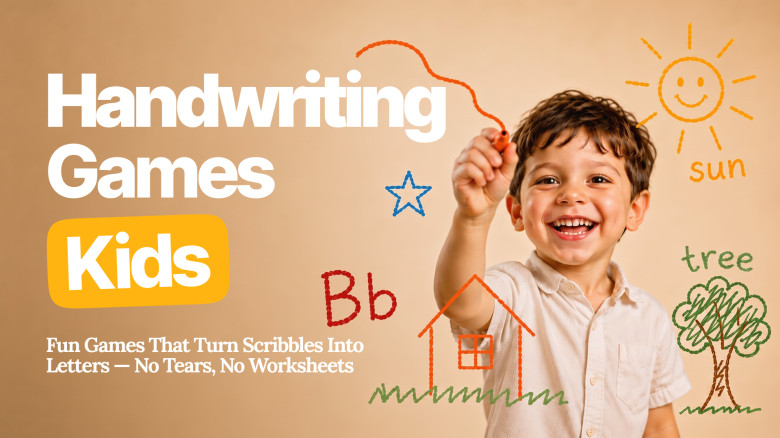
Handwriting Games for Kids: Playful, Science-Backed Games That Build Fine Motor Skills, Letter Recognition & Focus — for Preschoolers and Early Primary Kids
You know the scene. The pencil comes out, and so do the tears. The letters come out backwards. You honestly can't read what they just wrote. And every time you gently say “let's try again,” it turns into a meltdown. Here's the thing nobody tells you: your child isn't lazy, and they're not behind. Their little hand simply hasn't built the muscles and the hand-eye control that writing actually needs yet. This course fixes that — through 10 minutes of play a day. No worksheets. No fighting. Just simple games that turn scribbles into real letters.
We guarantee to refund the course purchase price, if the course did not meet your expectations. To request a refund, please email our Support Service at [email protected] within 14 calendar days from the purchase date.
Comments about the course
-

My daughter had started dreading school — not the lessons, the writing. Every morning was a battle because she was scared of being the one who couldn't do it. We did these games for a few weeks before she started, and the fear just… melted. She walks in now like it's no big deal.
-

Honestly, everything my son wrote was just scribbles — you couldn't tell a letter from a squiggle. Ten minutes of these games a day, and within a month actual words started showing up on the page. I saved the first one.
-

My son is in first grade and his handwriting was genuinely awful — the teacher kept sending work home to redo. Turns out it was never about effort, it was his fine motor skills. Once we built those up with the finger games, his letters finally steadied out.
-

First grade, and he kept writing b instead of d no matter how many times I corrected him. The 'letters as pictures' game was the thing that finally made it click. Three weeks and the mix-ups basically stopped.
-

My daughter's in second grade and writing had turned into tears every single afternoon — she'd rush, erase, tear the page. These games took the pressure right off. Now she actually asks to do her 'letter games' before homework.
Course includes
Sound Familiar? This Might Be Your Afternoon:
- They keep writing letters backwards (b for d, p for q) no matter how many times you correct them
- Big and small letters get all mixed up in one word — CaT, DoG
- You genuinely can't read what your own kid just wrote
- They grip the pencil in a tight little fist and their hand gets tired after a few lines
- Letters wander off the line, sizes jump all over the page
- “I can't do it” — before they've even picked up the pencil
- Homework starts — and two minutes later there are tears
- Teacher keeps saying “just needs more practice” — but more worksheets = more tears
Here's What Everyone Keeps Missing
We keep asking kids to write letters before their hand is ready to write letters. Good handwriting doesn't start with the letter — it starts with three simple things every child needs first:
Hand motor skills — the little muscles in the fingers and hand need to be strong enough to steer a pencil. If they're weak, letters come out shaky, messy, and off the line — no matter how hard the child tries.
Image thinking — young kids don't remember abstract shapes — they remember pictures. When a letter is tied to an image, it finally sticks in their memory instead of getting mixed up with a similar one.
Muscle memory — a letter becomes automatic only when the hand has repeated the movement enough times that it no longer has to think about it. That's the difference between “knowing” a letter and actually being able to write it smoothly.
When these three are in place, handwriting clicks on its own. When they're missing, more copying and more worksheets just pile frustration on top. That's why correcting a letter after it's already on the page rarely helps — the fix is building the foundation first, and the fastest way kids build it is through play.
Why choose this course?
- Targets the real root — hand strength and the hand-eye connection — not just copying letters
- Feels like play, so your child actually wants to do it
- Just 10 minutes a day, at home, with things you already have
- Fixes reversals and big/small mix-ups at the source, not with constant “no, try again”
- Works whether your child is just starting out or already dreads writing
- Ends the tears-before-homework routine for good
Academic plan
30 video lessons
- Lesson 1: Wake-Up Hands
- Lesson 2: Ready-Set-Grip
- Lesson 3: Press & Release
- Lesson 4: Roll & Catch
- Lesson 5: Texture Finger Race
- Lesson 6: Calm-Down Breaths
- Lesson 1: Perfect Pencil Grip
- Lesson 2: Steady Hands Start
- Lesson 3: Curve Control Spirals
- Lesson 4: Focus Spiral Trainer
- Lesson 1: Letter Pattern Match
- Lesson 2: Pattern Pals
- Lesson 3: Hand Match Game
- Lesson 4: Shape Market Match
- Lesson 5: Color Hunt Letters
- Lesson 6: Block Line Builder
- Lesson 1: Mirror Letter Drawing
- Lesson 2: Double-Hand Draw
- Lesson 3: Butterfly Wings Trace
- Lesson 4: Gliding Curves
- Lesson 5: Mirror Trace Path
- Lesson 6: Left-Right Mirror
- Lesson 7: Wall Swirls
- Lesson 8: Mirror Motion Maze
- Lesson 1: Loop & Curve Words
- Lesson 2: Zig & Swirl Letters
- Lesson 3: Frog Trail Words
- Lesson 4: Tree & River Lines
- Lesson 5: Spiral vs Lightning
- Lesson 6: Criss-Cross Tracks

After payment, you can immediately start practicing
- Click the "Get Access" button, enter your email in the field and you will be taken to a secure payment page.
- Complete the order process and you will instantly receive a password to access your personal NEWMINDSTART account.
- Take lessons, perform practical tasks, ask the author questions and discover new courses.
FAQ