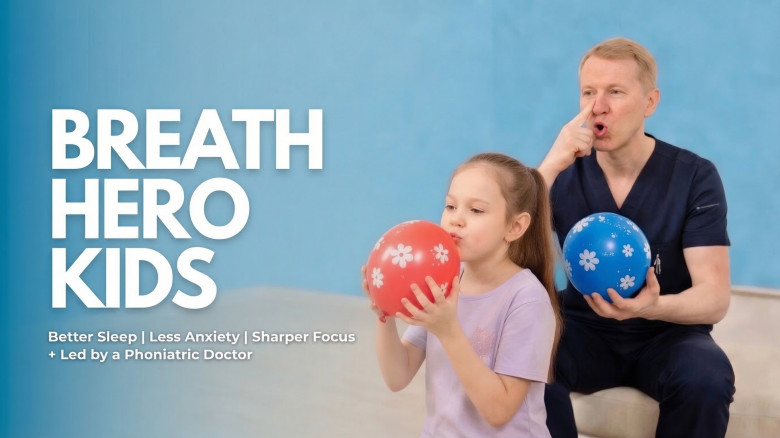
Breath Hero Kids: Fun Breathing Games for Kids by a Phoniatric Doctor
Is your child mouth breathing, snoring, waking up exhausted, or impossible to calm down? It's not a phase. It's a breathing pattern — and it's affecting their sleep, focus, and energy every single day. Breath Hero Kids fixes it through adventure-style breathing games kids actually beg to play. No nagging. No forcing. Just 10 minutes a day to build nasal breathing habits, calm the nervous system, and help your child sleep deeper, focus better, and feel like the hero they are.
We guarantee to refund the course purchase price, if the course did not meet your expectations. To request a refund, please email our Support Service at [email protected] within 14 calendar days from the purchase date.
Comments about the course
-

My son used to snore so loudly I could hear him from the hallway. Three weeks in, the snoring is almost gone. I stood at his door last night just listening to how quietly he was breathing. I actually cried.
-

My daughter would have full meltdowns every single night at bedtime. I thought it was just her personality. Turns out she just couldn't calm her body down. The Hot Chocolate breathing game is now our non-negotiable before sleep. Different child.
-

My son fights everything that feels like work. I braced myself. But he asked to do the Dragon Breath game three nights in a row without me saying a word. Three nights. That never happens.
-

I didn't expect much honestly. But after two weeks his teacher messaged me saying his focus in class had improved. I hadn't even mentioned the course to her. That's when I knew something real was happening.
-

We've tried apps, meditations, weighted blankets — nothing stuck. This stuck. Ten minutes, a few games, and my daughter is out within 20 minutes of bedtime. For us that's a miracle.
-

What got me was my son started doing the bee breathing on his own when he got frustrated. I never told him to. He just figured out it helped him calm down. That's not a course result — that's a life skill.
Course includes
Created by a Phoniatric Doctor: Rewire Your Child's Breathing Through Play
Check if your child shows any of these signs:
- Breathes through their mouth during the day
- Snoring, noisy or heavy breathing at night
- Wakes up tired no matter how long they sleep
- Bedtime is a battle — can't wind down, can't calm down
- Anxious, irritable, or emotional for no clear reason
- Struggling to focus or pay attention at school
- Frequent colds, allergies, or asthma flares
- Low energy — sluggish in the morning, exhausted by midday
- Breathes fast or shallow when stressed or upset
These aren't random symptoms. They're connected — by one root cause. Your child's breathing pattern is stuck in the wrong mode: mouth open, shallow, fast. And that pattern is quietly affecting their sleep, their mood, their brain, and their health every single day. Telling them to close their mouth won't fix it. It never will.
Why most breathing exercises don't work
Kids don't quit because they're lazy. They quit because exercises are boring — and boring doesn't build habits. What works is short, playful, repeated practice until nose breathing becomes automatic. That's why Dr. Kot built Breath Hero Kids — and why kids actually finish it.
In just 10 minutes a day, your child will:
Do fun adventure-style breathing games they actually beg to repeat — and build real, lasting change:
- Breathe through the nose day and night — less snoring, quieter sleep
- Fall asleep faster and wake up actually rested
- Feel calmer and less overwhelmed during the day
- Focus better at school with more sustained energy
- Have fewer meltdowns and emotional outbursts
- Reduce asthma and allergy flares
- Build stronger immunity through proper nasal breathing
- Feel like the hero they were always meant to be
Stop reminding. Start playing.
How Breath Hero Kids Works
Most kids don't feel like they're doing exercises — they feel like heroes on a mission. Every game has a purpose. Every session builds a real habit.
1) Activate nose breathing through play Fun adventure games train the body to close the mouth and breathe through the nose — naturally, automatically, without reminders.
2) Calm the nervous system in minutes Targeted breathing rhythms teach the brain to switch from stressed to calm — fewer meltdowns, faster wind-downs, better emotional control.
3) Build deep, restful sleep habits Evening breathing rituals signal the body it's safe to rest — so your child falls asleep faster, breathes quietly, and wakes up actually refreshed.
4) Strengthen focus and daily energy When the brain gets proper oxygen through nasal breathing, everything sharpens — attention, memory, mood, and stamina through the school day.
Why choose this course?
Fun, not a fight: It feels like a superhero adventure — kids stay engaged without you pushing.
Targets the real daily triggers: Sleep, anxiety, focus, and energy — where wrong breathing shows up most.
Easy to stay consistent: 10 minutes a day, guided step-by-step with simple game-based routines.
Better together: Do it alongside your child — 10 minutes of play that doubles as real bonding time.
Many parents notice changes within 1–2 weeks. No equipment. No prep. Just press play!
Academic plan
13 video lessons
The challenge:
Your child keeps their mouth open, and air isn’t properly warmed or filtered — the starting point of many future issues.
What we explain:
Our goal is to make nasal breathing automatic at rest — during play, reading, and sleep. We begin by helping your child feel airflow through playful exercises. Watch closely: does your child pinch their nostrils? Can they create a slow, smooth exhale?
Exercises:
“Smell the Flower”
Slow nasal inhale, hold for 1–2 seconds, slow mouth exhale. Repeat 3–5 times.
“Mirror Fog”
Breathe in and out through the nose to create mist on a small mirror. 5 times.
“Nose Train”
Fingers on the sides of the nose. Inhale through the nose, exhale softly while saying “choo-choo,” feeling vibration.
Reminder Game: “Lips Are Sleeping”
Gently remind your child during calm moments: “The lips are sleeping, the nose is working.”
Mini Gymnastics
Short sniffing inhales while clenching fists. 4 rounds of 4.
The challenge:
At rest, the tongue lies low or presses against the teeth — a major cause of open bite and interdental speech.
What we explain:
The correct “home” for the tongue is with its wide tip resting behind the upper teeth, gently lifted to the palate. This relaxed resting position is the foundation of proper swallowing.
“Find the Hills”
Explore the ridge behind the upper teeth with the tongue — that’s home.
“Mushroom”
Suction the tongue to the palate, open and close the mouth while holding. 5 seconds × 5.
“Elevator”
Tongue moves slowly from bottom floor to top floor (home). 5 times.
“Swings”
Alternate tongue position between upper and lower spots, first slowly, then faster.
The challenge:
Weak, open lips can’t support proper jaw and tongue position, leading to chin tension.
What we explain:
Our goal is to relax the chin and strengthen natural lip closure. Exercises are always done in front of a mirror — lips work, chin stays smooth.
“Elephant & Frog”
Lip tube → wide smile. 10 slow repetitions.
“Fence”
Hold a wide smile with closed teeth for 10 seconds.
“Stubborn Straw”
Hold a straw or cap using lips only (no teeth). 20–30 seconds.
“Air Battle”
Puff cheeks and gently press them with hands while holding air.
The challenge:
Tongue pushes between teeth, lips tighten, chin activates — reinforcing bite problems.
What we explain:
Proper swallowing is almost invisible: tongue rests in its home, teeth closed, lips relaxed, chin soft.
“Mushroom + Swallow”
Hold tongue suction, swallow saliva without lip or chin movement.
“Rolling the Pea”
Roll an imaginary pea along the palate, then swallow.
Food Practice
Small spoon of thick yogurt — gather with tongue, swallow calmly.
Water Practice
Hold water, lift tongue to home, swallow slowly along the center line.
The challenge:
Weak or tense chewing muscles, one-sided chewing, bruxism, jaw asymmetry.
What we explain:
Healthy chewing is symmetrical, calm, and coordinated. All jaw movements are smooth and pain-free.
“Polite Crocodile”
Slow, straight jaw opening — focus on symmetry, not width.
“Clock”
Small jaw movements side-to-side and forward-back.
“Strongman”
Gentle resistance exercises for opening and closing.
Food Training: “Little Squirrel”
Chew firm food alternately on each side with closed lips.
The challenge:
Clumsy fingers often reflect immature neural pathways connected to speech.
What we explain:
By activating the hands, we stimulate nearby speech centers in the brain. Precision, pinch strength, and tactile play are key.
“Strong Pinch”
Stretch a soft band using thumb, index, and middle fingers.
“Harvest Time”
Pick up beads or beans one by one using a pinch grip.
“Finger Massage”
Roll a spiky ball or pinecone between fingers.
“Guess the Object”
Find hidden toys by touch alone.
Finger Gymnastics with Rhymes
Bilateral Brain Exercise:
Classic Fist–Palm–Edge sequence, one hand, then both.

After payment, you can immediately start practicing
- Click the "Get Access" button, enter your email in the field and you will be taken to a secure payment page.
- Complete the order process and you will instantly receive a password to access your personal NEWMINDSTART account.
- Take lessons, perform practical tasks, ask the author questions and discover new courses.
FAQ