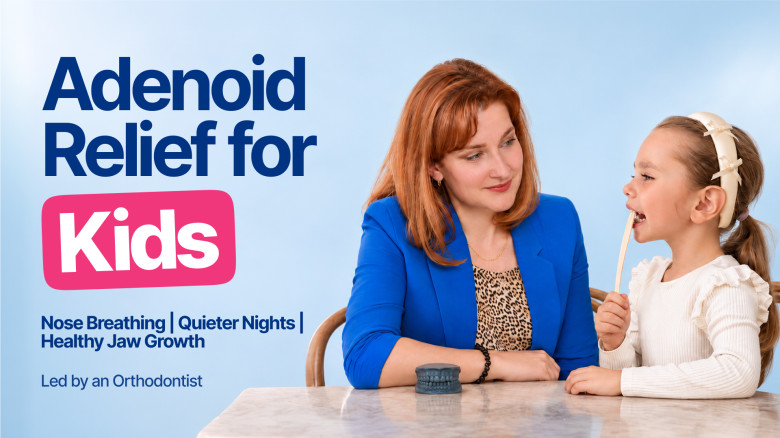
Adenoid Relief for Kids: Breathe Through the Nose & Sleep with the Mouth Closed
The ENT said "let's wait, they'll shrink." Or said "let's operate." Either way, tonight you'll still watch your child sleep with their mouth open — snoring, sweaty, waking up tired. Sprays, rinses, allergy meds calm the nose for a while. None of them teach your child to breathe through it. Adenoid Relief for Kids works on what adenoids leave behind: a tongue that drops, lips that stay apart, a mouth that forgets the nose. Created by an orthodontist and mom of two who went through this with her own son. Simple games, 10–15 minutes a day, for kids from age 1.
We guarantee to refund the course purchase price, if the course did not meet your expectations. To request a refund, please email our Support Service at [email protected] within 14 calendar days from the purchase date.
Comments about the course
-

ENT said wait and see till he's 6. Great, but what do I DO until then?? 😩 This gave me an actual plan. Week 2 — I caught him watching cartoons with his mouth CLOSED. I took a picture.
-

We spent $300+ on sprays, allergy meds, two rounds of antibiotics… his nose would clear for a week, then right back to mouth open 💸 Nobody ever worked on the habit itself. The balloon game is his favourite part of the day now 🎈
-
Skeptic here. Didn't think tongue exercises could do anything for a 3yo. Week 1 → he thought it was silly. Week 3 → he asks for 'the ball one' before bed. Week 5 → quieter nights, and my husband noticed before I did.
-

Our orthodontist said 'narrow palate' and started talking about expanders 😬 This course finally explained WHY. We're still seeing her, but now we're working on the cause at home too.
-
Adenoids out last spring. Everyone said problem solved. It wasn't — still sleeping with his mouth open 😞 The lesson on why the habit stays after surgery was the first thing that made sense. A month in, his lips stay together way more.
-

The dark circles. In every photo. People asked if she was sick 💔 We do 10 minutes after bath now. Week 4 she woke up and said 'I'm not tired' — first time I can remember.
Course includes
Kids Don't Grow Out of Mouth Breathing. They Grow Into It.
Are these familiar?
- Your child sleeps with their mouth open — even "just sometimes"
- You hear snoring or heavy, noisy breathing through the night
- They wake up tired and cranky after 10 hours of sleep
- Dark circles under the eyes that never really go away
- A stuffy nose that seems to last all year
- Lips apart during the day — in front of the TV, reading, playing
- Ear infections that keep coming back
- The ENT said "enlarged adenoids" — then "let's wait" or "let's operate"
- The dentist mentioned a narrow palate, crowding or braces
- Deep down, you worry you missed the early signs
Here's what nobody tells you
Adenoids are only half the story. When a child's nose is blocked for months, the body finds a backup — the mouth. The tongue drops from the palate. The lips stop closing. Open-mouth breathing becomes the default, day and night.
That's the loop: blocked nose → the mouth opens → the tongue drops → the upper jaw gets less support and the nose gets less air → breathing through the nose feels even harder → the mouth stays open. Adenoids didn't do this alone. The loop did. And a loop can run the other way.
Over the years, some children develop what doctors call "ADENOID FACE" — a long, narrow face, a high palate, crowded teeth. Most jaw growth happens before age 12.
Sprays clear the nose. Antibiotics calm an infection. Surgery removes the tissue. Every one of them works on the nose. None of them teaches the tongue, the lips and the breathing what to do — which is why kids whose adenoids are out can still sleep with their mouths open. Private myofunctional programs for kids cost $750 to $2,000+. This part you can start at home, tonight.
Breathe Through the Nose. Sleep with the Mouth Closed.
In just 10–15 minutes a day with Adenoid Relief for Kids:
- The mouth stays closed more often — at play, at the table, in front of the TV
- Quieter, calmer nights — less snoring and heavy breathing
- Mornings without the "tired after 10 hours" look
- The tongue learns its home — up on the palate, supporting the upper jaw
- Stronger lips that stay closed without reminders
- A clear nose routine — rinsing the right way, morning and night
- You finally understand what the adenoids are doing — and what to ask your ENT
Your child isn't lazy about closing their mouth, and you haven't missed your chance. The right muscles were simply never taught their job. Now they will be.
How Adenoid Relief for Kids Works
1. See what's really going on. Learn the signs of enlarged adenoids and check how your child breathes, day and night. 2. Clear the nose. The right way to rinse a child's nose, so breathing through it becomes possible. 3. Send the tongue home. Myofunctional tongue games teach it to rest up on the palate. 4. Close the lips. Simple exercises strengthen the muscle that keeps the mouth shut. 5. Make the nose the default. Breathing games — the balloon, the floating ball, the stick — retrain how your child breathes.
Why choose this course?
Everyone treats the nose. This trains the breathing.
- Created by an orthodontist who sees what years of mouth breathing do to growing jaws
- Built around adenoids — not generic breathing tips
- Adenoids, nose, bite, face and posture explained in plain words
- Works alongside your ENT and dentist — not instead of them
- Games simple enough for kids from age 1
- 10–15 minutes a day at home, no clinic visits
Academic plan
18 video lessons
What this course covers, and why ages 3 to 10 matter most for a growing face and jaw.
How tonsils and adenoids protect the airway, and why they sometimes grow too big.
The tonsils you can see, and what tonsillitis and enlargement really mean.
Infections, allergies and other triggers that keep tonsil tissue swollen.
From conservative care to the cases where doctors consider surgery.
Frequent colds, allergies and poor nasal airflow — the drivers behind enlarged adenoids.
Why adenoid size doesn't always match how hard your child is breathing.
Snoring, sweating, tiredness, poor focus, ear infections, dry mouth — the full picture.
How a low tongue and mouth breathing affect the upper jaw and the bite.
The tired look, the open lips, the forward head — and the cycle behind them.
The exams doctors use, and why the ENT, dentist and orthodontist work best together.
Conservative care, surgery, and why the breathing habit needs training either way.
Dry mouth, cavities and gums — what mouth breathing does to teeth.
A simple routine for a clearer nose. Your task: watch how your child breathes, day and night.
The balloon, the floating ball, the stick — nose breathing your child will want to repeat.
Playful exercises that teach the tongue to rest up on the palate.
Smiles, kisses and balloons that strengthen the lips so they stay together.
How to fit 10–15 minutes a day into your family's routine.

After payment, you can immediately start practicing
- Click the "Get Access" button, enter your email in the field and you will be taken to a secure payment page.
- Complete the order process and you will instantly receive a password to access your personal NEWMINDSTART account.
- Take lessons, perform practical tasks, ask the author questions and discover new courses.
FAQ